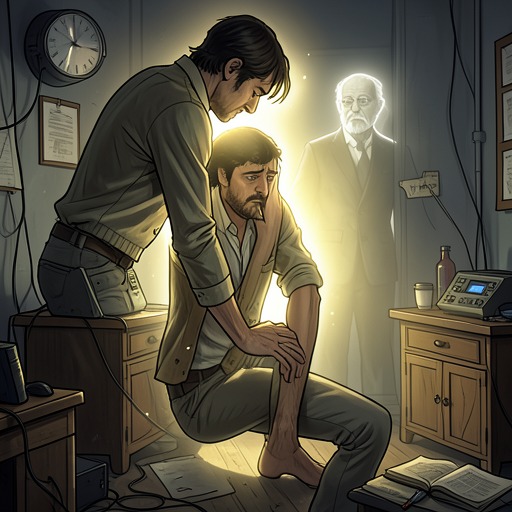
“Lo, I am with thee always”
Life After Life“Lo, I am with thee always” is a scriptural phrase that shifts in one industrial accident from familiar words with little personal force into a perceived presence guiding a man out of mortal danger. In the account, the phrase is not offered as a theological proof: it is remembered as part of an immediate experience in which a glow and a voice point toward escape, and the man later credits that guidance with the courage others noticed in him.
Familiar Words in an Immediate Crisis
The man was trapped inside a huge vat as very hot acid and steam were pumped in under high pressure. He had moved as far into a corner as he could, yet the heat burned through his clothing. Unable to see and unable to open his eyes against the heat, he concluded that he would be scalded to death within minutes.
At the moment he gave up hope, the whole area seemed to fill with a glow. Along with it came the verse “Lo, I am with thee always,” which he had heard throughout his life but which, until then, had never meant much to him. Its force in the episode came not only from recognition: the words seemed to come from a direction that he later understood to be the only way out.
The Light as a Way Out
Although he kept his eyes closed, the man said he could still see the light. He followed it through the danger. The account emphasizes the mismatch between ordinary sight and what he experienced: he maintained that his eyes had remained closed, and the doctor did not treat them afterward because no acid had entered them.
The phrase thus appears within a report of rescue, rather than as a detached recollection or a general statement of belief. The man’s account links the words, the glow, and the direction of escape, while leaving the experience in the form in which he reported it. The book presents it as one example of the unusual rescue accounts discussed among near-death phenomena, not as a universal sequence that every experiencer undergoes.
Courage After the Accident
When the man returned to work, colleagues remarked on how calm he had been after the accident. He rejected the idea that this composure came from an unusually brave nature: he said he was not a courageous man. Instead, he attributed both his escape and the calm others observed to the unseen guidance he had experienced. In his account, the voice that led him out was also the source of his courage.
That aftermath gives the remembered verse a continuing role. Its significance is measured not only by the man’s description of the crisis but by the change he reported in how he understood his own conduct afterward: calmness that seemed unlike him became evidence, for him, of help beyond his own courage.
Religious Meaning and Limits of the Account
The episode sits within a broader discussion in which the book distinguishes reported experiences from settled theological conclusions. The author notes that some ministers considered near-death accounts compatible with Scripture, and that theologians he consulted regarded a vision’s effects—such as drawing a person closer to God or toward religious teachings—as relevant to judging it. Those observations provide a context for the man’s interpretation of the verse, but they do not establish that the phrase or the experience proves a doctrine.
Its meaning remains grounded in the particular account: a verse long familiar but previously unimportant, heard amid an apparently fatal emergency, associated with a light and a direction, and recalled afterward as the source of unexpected calm. The movement from rote familiarity to urgent personal significance is what makes “Lo, I am with thee always” a distinctive expression in the rescue narrative.